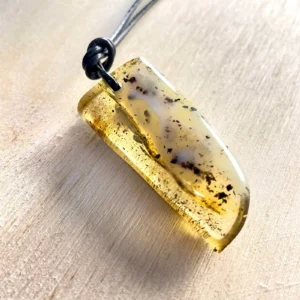
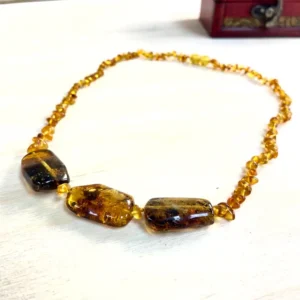
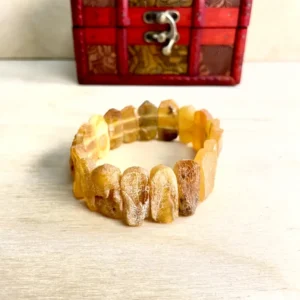
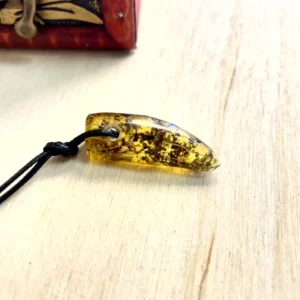
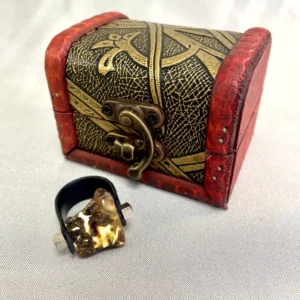
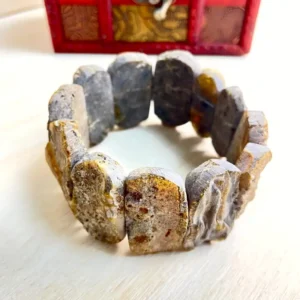
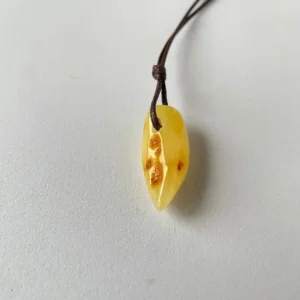
Baltic amber is one of the most fascinating substances ever discovered – a gemstone that isn’t a mineral at all, but the fossilized resin of ancient trees. For centuries, it has been shaped into amber necklaces, amber bracelets, and amber rings, admired for its natural beauty and historical mystery.
Yet one question continues to intrigue collectors and scientists alike:
How old is Baltic amber?
The answer reveals not only the incredible age of this organic gemstone, but also the story of entire prehistoric ecosystems that existed tens of millions of years before humans walked the Earth.
In this article, we’ll explore the true age of Baltic amber, how scientists determined it, where it formed, and why it remains one of the most ancient and valuable natural materials known to humankind.
What Is Baltic Amber?
Before understanding its age, it helps to define what Baltic amber actually is.
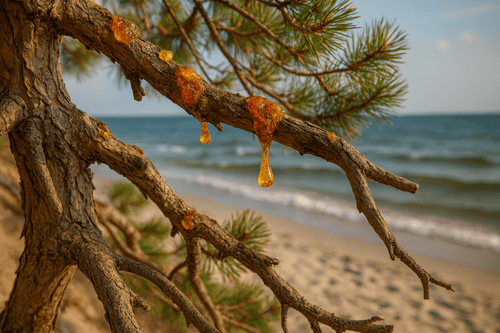
Amber is fossilized tree resin – not sap – that hardened and polymerized over millions of years. It originated from ancient forests that once covered vast regions of northern Europe. The trees that produced this resin belonged mainly to the now-extinct species Pinus succinifera, often referred to as the “amber pine.”
The term “Baltic amber” refers to amber found in the geological region surrounding the Baltic Sea – especially along the shores of Lithuania, Latvia, Poland, and Kaliningrad (Russia). This area contains the largest amber deposit on Earth, accounting for over 90% of the world’s known amber.
Unlike younger ambers found elsewhere (Dominican, Mexican, or Burmese varieties), Baltic amber is the most ancient, stable, and chemically distinct form – rich in succinic acid, the compound that gives it its scientific name “succinite.”
The True Age of Baltic Amber: 44 to 54 Million Years Old
So, how old is Baltic amber?
The short answer: approximately 44 million years old – a testament to time, transformation, and nature’s ancient artistry.
The Eocene Epoch
Baltic amber formed during the Eocene Epoch, a division of the geological timescale that lasted from about 56 to 33.9 million years ago. Specifically, the resin that became Baltic amber was secreted during the Middle to Late Eocene, around 44–49 million years ago.
This era was characterized by:
- A warm, humid climate across much of Europe.
- Vast coniferous and subtropical forests covering what is now northern Europe and parts of western Russia.
- The emergence of early mammal species, including primitive primates.
How Scientists Determined the Age
Scientists dated Baltic amber using several geological and chemical techniques:
- Stratigraphic analysis: Baltic amber is found within the “Blue Earth” layer — a specific sedimentary deposit within Eocene marine sands. The fossils and microfauna in these layers correspond to the Middle Eocene (~44 million years ago).
- Paleontological correlation: Insects, plants, and pollen trapped inside amber inclusions match species known from other Eocene formations. This consistency allows researchers to estimate the amber’s age based on biological evidence.
- Radiometric dating of associated minerals: While amber itself cannot be directly dated (it lacks radioactive isotopes), the surrounding rock layers can be. Potassium-argon and argon-argon dating methods have confirmed an age of roughly 44 ± 2 million years for Baltic amber-bearing strata.
The Amber Forests: Where Baltic Amber Was Born
To understand why Baltic amber formed in this particular region and time, we must imagine a lost world — the so-called Amber Forest (Succinite Forest).
Location of the Amber Forest
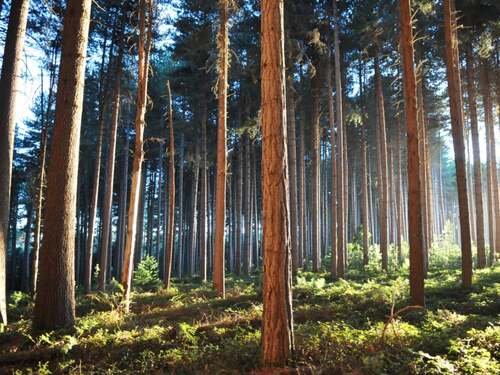
During the Eocene, much of northern Europe was covered by dense coniferous forests stretching from modern-day Scandinavia and Germany to Belarus and western Russia.
The center of this ancient forest ecosystem was located in what is now the Sambia Peninsula (Kaliningrad region) — the richest amber-bearing area known to science.
The Trees That Made Amber
The main resin-producing species belonged to the Pinaceae family, with Pinus succinifera being dominant. These trees exuded sticky resin to:
- Protect themselves from insects.
- Seal wounds after storms or fires.
- Defend against fungal infection.
Over time, the resin dripped down tree trunks, covering insects, leaves, and bark fragments, and hardened upon exposure to air.
How Baltic Amber Formed Over Millions of Years
The process that turned soft resin into fossilized amber took millions of years and involved several stages of transformation.
1. Resin Secretion and Burial
The resin oozed from ancient trees and often fell to the forest floor. Some pieces were washed into rivers and carried toward the ancient Eocene Sea – the body of water that would later become the Baltic Sea basin. Over time, sediment slowly covered these resin pieces, protecting them from oxygen and decay.
2. Polymerization and Fossilization
Over time, the volatile oils evaporated, and the organic molecules within the resin polymerized, forming a stable, cross-linked structure. The pressure from overlying sediments further solidified it.
The result was succinite – the stable, hardened form of amber that resists melting, decay, and time itself.
3. Geological Movement and Modern Deposits
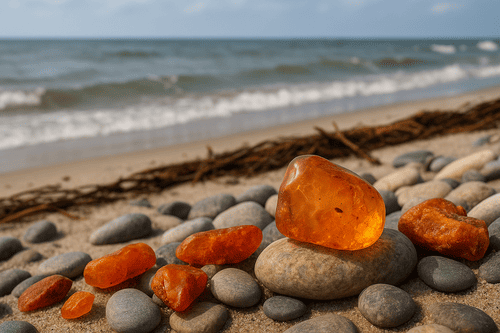
Millions of years later, glacial activity and coastal erosion redistributed amber nodules. This explains why Baltic amber can now be found washed up on beaches along the Baltic coast – particularly after strong storms.
These natural processes transformed Baltic amber into a material that is not just ancient, but remarkably well-preserved, carrying traces of life from an entirely different world.
How Baltic Amber Compares in Age to Other Amber Types
To appreciate just how ancient Baltic amber is, it helps to compare it to other well-known ambers found around the world.
| Amber Type | Estimated Age | Region | Key Features |
|---|---|---|---|
| Baltic Amber (Succinite) | 44–49 million years | Baltic Sea (Lithuania, Latvia, Poland, Kaliningrad) | Rich in succinic acid, many inclusions, stable |
| Dominican Amber | 15–20 million years | Caribbean (Dominican Republic) | Transparent, sometimes blue fluorescence |
| Mexican Amber | 22–30 million years | Chiapas, Mexico | Yellow to red hues, tropical inclusions |
| Burmese Amber (Myanmar) | 95–99 million years | Myanmar (Burma) | Cretaceous period, contains dinosaur-era fossils |
| Romanian/Rovno Amber | 33–40 million years | Eastern Europe | Similar chemistry to Baltic amber |
| Sicilian Amber (Simetite) | ~20 million years | Italy | Yellow-orange color, volcanic origin |
From this comparison, you can see that while Burmese amber is older in geological terms, Baltic amber is the most significant in both abundance and preservation quality, providing unparalleled insight into the Eocene world.
Fossils Inside Baltic Amber: Time Capsules of the Eocene
One of the most remarkable aspects of Baltic amber’s age is what it preserved.
Within these golden stones are perfectly fossilized insects, plants, and even tiny vertebrates that lived 44 million years ago.
Typical Inclusions in Baltic Amber
- Insects: flies, ants, beetles, spiders, and wasps.
- Plant matter: pine needles, moss, and flower fragments.
- Air bubbles: containing samples of the Eocene atmosphere.
- Microorganisms: fungi and bacteria, sometimes visible under magnification.
Scientific Importance
Each inclusion serves as a fossil record – a preserved fragment of life from the Eocene forests. Scientists have used them to reconstruct:
- Ancient ecosystems.
- Climate conditions.
- Evolutionary history of insects and plants.
This is why Baltic amber is not just a gemstone – it’s a paleontological treasure, studied by universities and museums around the world.
Why Age Matters: The Uniqueness of Baltic Amber
Knowing how old Baltic amber is deepens appreciation for its rarity and authenticity. Its ancient origin contributes directly to its durability, chemical stability, and global value.
Age and Value
Older amber is generally more stable and less likely to degrade. Because Baltic amber formed during the Eocene, it has undergone millions of years of natural hardening, giving it a warm, durable structure ideal for fine amber jewelry.
Age and Inclusions
Amber from younger deposits often contains more recent tropical species, but Baltic amber inclusions preserve extinct Eocene life forms found nowhere else. This makes it both a scientific and artistic treasure.
Age and Chemistry
Baltic amber’s high succinic acid content (up to 8%) is directly related to its age and the type of tree that produced it. No other amber type shares this exact chemical composition.
Modern Baltic Amber Deposits and Their Discovery
Today, the largest amber deposits still exist in the Kaliningrad region, particularly in the Yantarny quarry, where over 400,000 tons of amber are estimated to remain.
Smaller quantities wash ashore in Lithuania (Palanga) and Poland (Gdańsk region) – inspiring centuries of local craftsmanship in Baltic amber necklaces, bracelets, and rings.
Because these deposits originate from Eocene formations, every piece of genuine Baltic amber – no matter how small – carries 44 million years of natural history.
Frequently Asked Questions About the Age of Baltic Amber
Q1: How old is Baltic amber exactly?
Baltic amber formed during the Eocene epoch, approximately 44–49 million years ago.
Q2: How do scientists determine the age of amber?
They analyze the sedimentary layers where amber is found, date the surrounding minerals, and compare fossilized inclusions to known species from the same era.
Q3: Is Baltic amber older than Dominican amber?
Yes. Dominican amber is about 15–20 million years old, while Baltic amber is more than twice that age.
Q4: Can Baltic amber contain dinosaur DNA?
No. Dinosaurs went extinct about 66 million years ago, while Baltic amber formed around 44 million years ago – long after the dinosaurs disappeared.
Q5: Does older amber mean higher quality?
Generally, yes. Baltic amber’s geological age contributes to its hardness, chemical stability, and ability to preserve ancient inclusions.
Q6: Where is the oldest amber in the world found?
The oldest known amber comes from Myanmar (Burmese amber), dating back about 99 million years, but Baltic amber remains the most studied and prized.
Final Thoughts: 44 Million Years of Light and Memory
So, how old is Baltic amber? About 44 million years – an age almost impossible to comprehend. Each piece you hold formed in the heart of prehistoric forests when the Earth was warmer, greener, and alive with ancient species now long gone.
Every polished bead in a Baltic amber necklace, every gleaming stone in an amber ring, and every smooth charm in a Baltic amber bracelet is a fragment of deep time – sunlight and history fossilized together.
Baltic amber isn’t just old.
It’s timeless – a living memory of Earth’s golden past, brought from the ancient Eocene forest to your hands today.