Amber has long been admired for its beauty and ancient provenance, and across cultures many people have attributed to it various healing properties — a natural remedy, talisman, or calming aid. The idea that wearing amber jewelry such as necklaces, bracelets, or rings may offer physical, emotional, or energetic benefits has persisted across centuries and folk medicine traditions. Moreover, these beliefs continue today, even as scientific research attempts to clarify what is supported and what remains speculative.
In this article we’ll examine:
- Traditional and historical uses of amber for healing
- What modern scientific studies reveal or do not confirm
- How amber jewelry might be thought to “work” according to proponents
- Safety, skepticism, and balanced perspectives
- Practical advice for those who enjoy amber for wellness purposes
A Brief History: Amber in Traditional Healing Systems
The belief in amber’s therapeutic or protective powers reaches back to ancient civilizations. For example, the Greek physician Hippocrates described ways amber was used in various treatments. Medieval European lapidaries and medicinal manuscripts also included amber, often in powdered form or as amulets intended for protection, pain relief, or purification.
In Chinese traditional medicine, amber (succinum, hupo) appears in texts as a calming agent used to ease palpitations, restlessness, insomnia, and more. Across the Baltic region, folk traditions likewise used amber as a charm believed to soothe inflammation or respiratory discomfort. Consequently, amber’s reputation as a healing stone grew long before modern science attempted to assess it.
What Are the Claimed Healing Properties of Amber?
Across traditional and modern wellness communities, amber jewelry is often associated with the following claims:
- Pain relief and anti-inflammatory support
- Stress reduction, calming, and emotional balance
- Immune support and detoxification
- Healing and wound repair
- Respiratory and throat comfort
- Improved sleep and neurological calm
- Antibacterial and antimicrobial activity
These claims vary widely. Some rely on anecdotal experience, while others align slightly with biochemical or laboratory findings. Nevertheless, controlled human trials remain limited, so many claims remain unverified.
Scientific Evidence: What Research Actually Shows
Although scientific research on amber is still developing, several studies provide intriguing insights.
Amber extract in stress and longevity research
One study using Caenorhabditis elegans (a model organism) found that amber extract improved stress resistance and longevity. Researchers suggested that amber influenced the insulin / IGF-1 signaling pathway through factors such as DAF-16 and heat shock proteins. Although promising, these findings come from laboratory organisms, not humans.
Neuroprotective effects observed in cell culture
Another study explored whether amber extract could protect dopaminergic nerve cells, noting positive outcomes under controlled laboratory conditions. However, these results do not automatically indicate that wearing amber jewelry produces similar effects in human biology.
Antibacterial potential
Researchers have isolated amber-based compounds, including abietic-acid derivatives, that demonstrated antibacterial effects on gram-positive bacteria in laboratory settings. While interesting, jewelry worn on the skin does not replicate these experimental conditions.
General limitations in research
- There are very few human clinical trials.
- Succinic acid exposure from jewelry remains minimal and may not create measurable effects.
- Many perceived benefits rely on tradition, symbolism, or subjective experience.
- Any jewelry can pose risks for infants and very young children, so caregivers must remain cautious and supervise closely.
Therefore, current science neither fully confirms nor dismisses amber’s healing reputation. Instead, it offers early insights that require further study.
Mechanisms Proposed for How Amber Jewelry May Work
Proponents of amber’s healing potential often mention several possible mechanisms.
Skin-warmed release of succinic acid or trace compounds
According to folk theory, warmth from the skin may encourage amber to release micro-amounts of succinic acid, which could then absorb into the skin and help with inflammation.
Electrostatic or energetic effects
Amber can become electrically charged when rubbed, a phenomenon known since ancient times. Because of this, some believe amber interacts with the body’s energy fields to promote balance.
Aura or energetic cleansing
In metaphysical traditions, amber is described as a stone that absorbs or neutralizes unwanted emotional energy, supporting clarity and grounding.
Placebo and psychophysiological influence
Wearing an object believed to have healing power may create a sense of calm or confidence. As a result, stress levels may decrease, creating real physiological benefits.
Evaluating Specific Claims: What Seems More and Less Plausible
The following table summarizes several commonly discussed claims, the theories behind them, and notable weaknesses.
| Claim | Supporting Theory | Weaknesses |
|---|---|---|
| Pain relief | Succinic acid anti-inflammatory properties | Likely too low absorption; no trials |
| Stress reduction | Folk belief + indirect stress evidence | Non-human data; subjective |
| Antibacterial action | Lab isolation of active compounds | Jewelry contact ≠ systemic effect |
| Wound healing | Historical use | No modern clinical proof |
| Respiratory support | Folk practices | Mechanism unclear |
Safety, Ethical Use & Balanced Expectations
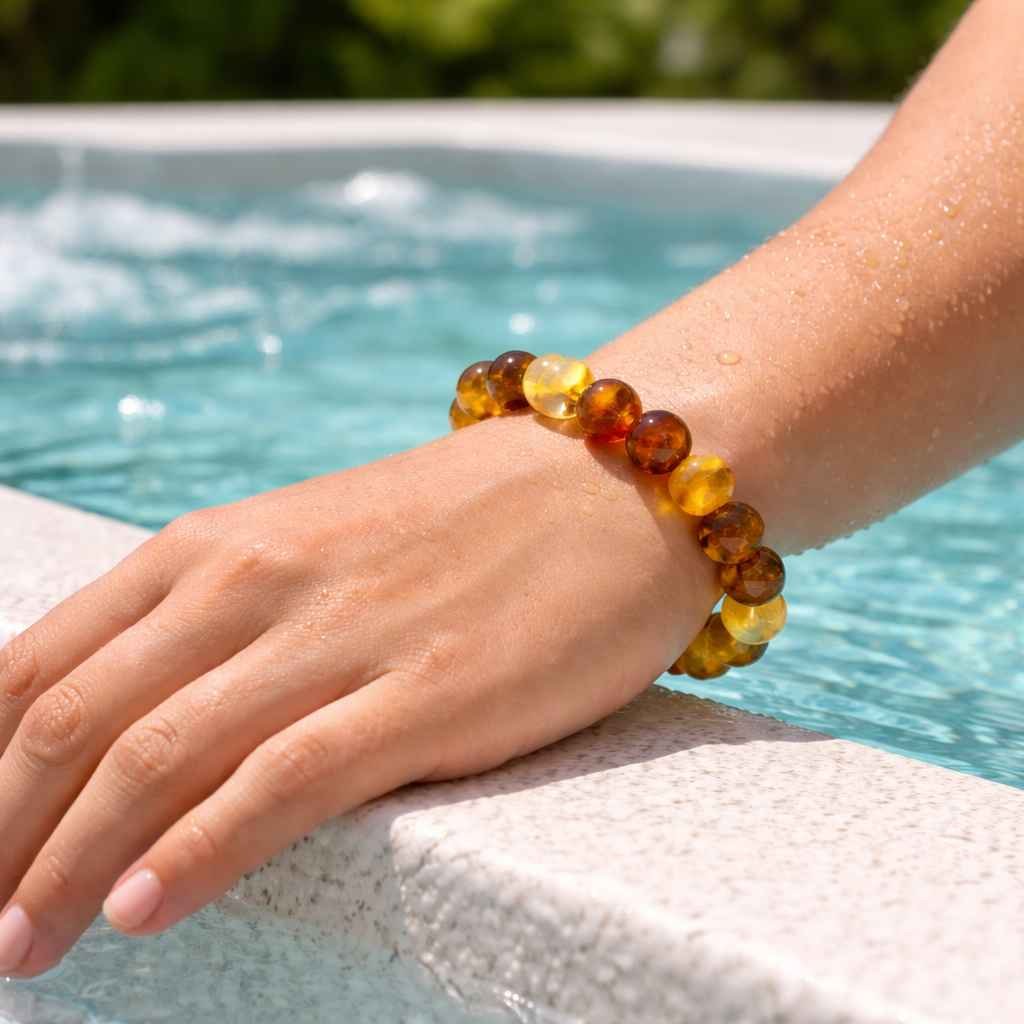
Amber jewelry is generally safe for adults, especially when worn as necklaces, bracelets, or rings. Still, individuals with sensitive skin may benefit from choosing polished pieces and cleaning them regularly. Moreover, amber should complement rather than replace professional medical care. Ethical sellers clearly describe amber’s origin, enhancements, and the limits of wellness claims. Additionally, psychological and ritual effects may meaningfully contribute to perceived benefits.
How Amber Jewelry Is Used in Wellness Practices
- Daily wear: People often wear amber continuously to maintain contact with the skin.
- Localized placement: Some choose to wear amber near areas of discomfort, such as wrists or joints.
- Massage tools: Smooth amber stones provide warmth and a soothing tactile experience.
- Amber tinctures or elixirs: Some traditions use powdered amber in topical blends.
- Mindfulness and ritual: Amber frequently appears in meditation and grounding practices.
- Cosmetic and skincare products: Succinic acid or amber powder sometimes appears in creams and serums.
How to Think About the Healing Properties of Amber Jewelry
When evaluating amber for its healing reputation, remember that the strongest evidence currently comes from laboratory or molecular research. Human evidence remains limited. Emotional and energetic claims often reflect metaphysical traditions rather than biomedicine. Nevertheless, many people enjoy amber for its calming presence, tactile warmth, and symbolic meaning. Consequently, a balanced approach respects both tradition and scientific limitations.
Frequently Asked Questions
Q1: What healing properties do people associate with amber jewelry?
Common claims include pain relief, anti-inflammatory support, stress reduction, improved rest, and emotional balance.
Q2: Does science prove amber heals the body?
Not yet. Although early lab studies show promise, comprehensive human research remains limited.
Q3: How might amber jewelry work?
Proposed mechanisms include succinic acid release, electrostatic influence, metaphysical energy ideas, and psychological effects.
Q4: Is amber safe to wear?
Most adults can wear amber safely. Nonetheless, any small jewelry item requires caution around young children and supervision.
Q5: Can amber help with joint pain?
Some people believe amber offers comfort because of warmth and tradition. However, scientific evidence remains limited, so medical advice is still essential.
Q6: Why does amber feel calming?
Many attribute the calming sensation to symbolism, tactile comfort, or the psychological effects of wearing a meaningful natural material.
Final Thoughts: Beauty, Belief, and Balance
Amber’s healing reputation sits at the crossroads of tradition, personal experience, and early scientific curiosity. Although strong confirmation from modern science remains limited, amber still offers beauty, warmth, symbolism, and a sense of grounding. Therefore, many people enjoy amber jewelry both for its aesthetic value and for the meaning they attach to it.